
A First in Fintech: The AI-Native Options Intelligence API
Today we launched something we believe is a first in fintech:
An AI-native options intelligence API built specifically for agent-led development.
This is not a raw market data feed.
It’s a structured intelligence layer.
Instead of exposing ticks, quotes, and loosely organized analytics, version 2 of our API exposes derived market structure:
- Gamma structure (support, resistance, flip levels)
- Regime diagnostics (positioning + volatility context)
- Call pressure and flow imbalance
- Skew and IV metrics
- Deterministic interpretation layers
Every endpoint is designed with agent readability in mind.
- Schemas are explicit
- Outputs are structured
- Interpretations are deterministic
The result: AI systems like Claude can reason over the data without reverse-engineering meaning from unstructured fields.

Built for Agent-Led Development
With v2, you can simply point Claude to our LLM specification:
👉 https://stocks.tradingvolatility.net/api/v2/llm-spec
From there, Claude (or other LLM systems) can understand the full surface area of Trading Volatility endpoints, parameters, response schemas, and data semantics.
From there you can:
- Build trading dashboards
- Build quantitative research tools
- Build agents that compare gamma structures across tickers
- Fetch and contextualize call pressure
- Generate regime summaries across the market
- Automate structured decision workflows
This is infrastructure for AI-native finance.
Structured for Machines. Designed for Workflows.
Most financial APIs were built for humans first and adapted for machines.
This API was built for machines first.
- Derived structure
- Options-specific regime intelligence
- Deterministic interpretation
- Agent-readable schemas
We believe the next generation of trading tools won’t just visualize data — they’ll reason over structured intelligence.
This is the foundation for that.
Explore the human-readable docs and try it live here:
https://stocks.tradingvolatility.net/api/v2/docs
What Happens When AI Uses It
When we tested this out we asked Claude to:
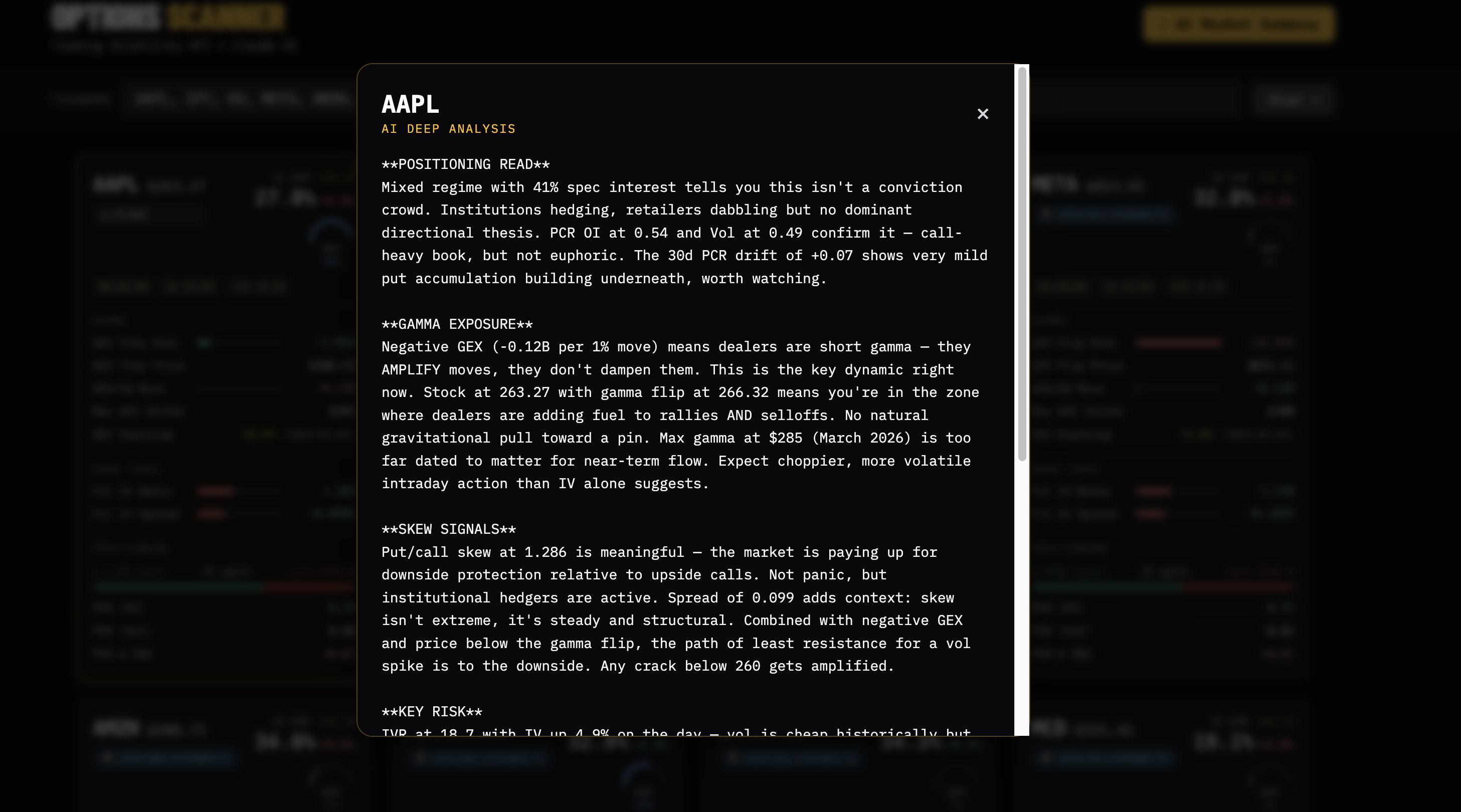
“Use the information available from this API to build something cool.”
In less than 5 minutes it built a working dashboard. (The Source code for the Options Scanner dashboard built by Claude using the Trading Volatility API is available on Github.)

We’re just getting started.